Global Bass Online October 2001



Global Bass Online October 2001
|
|
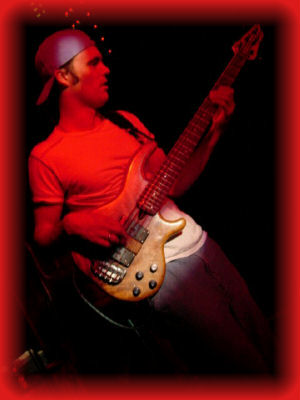
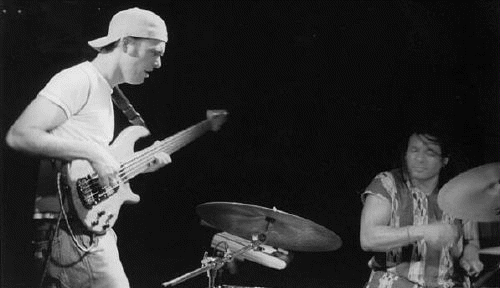
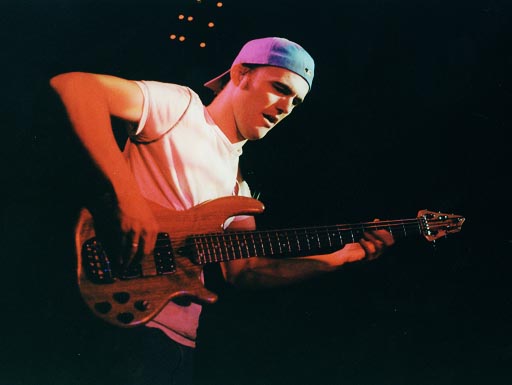
Gee-Wiz Gwizzy’s Bizzy ! by
Phil Dipietro You know, in the music world, even with this increasingly instantaneously
available world of internet based, fat pipe, cable-modemed information where all
is at your fingertips, mp3’s are shared, schedules are instantly updated and
discographies abound, there is still nothing like word of mouth and personal
recommendation. In largest part,
it’s still how musicians get gigs, even at the highest of levels. It’s also
why, when someone in the bass world of the stature of Matt Garrison (www.garrisonjazz.com)
[I’m a journalist-but I must say an unabashed fan of Matt- I’ll
go on the record as stating he is the best electric bassist
today (send me all the e you want on that one)] -
mentions an unpronounceable name to me for the third time, I write it
down. Here’s how that went. ME: “Ok, that’s it ..I’m writing it down this time…Yannick what? Huh? How old? Oh, that’s Polish , huh?” MATT: “Well, it’s, Janek with a J… and its Gwizzzdahlllaa..that’s G-w-i-z-d-a-l-a. And he’s English, like from England, man. “ ME: “Gwizdal..how’d you find out about this guy?” MATT: “He called me..he came over …we played…we’re playing A LOT these days..” ME: “Oh, you gave him a lesson, huh?” MATT: “No, we play He doesn’t need any lessons, man! He’s one of the young cats man!” ME: “Uh, I thought you were a young cat.” MATT: “Well, thanks, but he’s… like 20.” This causes me to- well, obviously to have the idea for a bass duo cd- but
then, more responsibly, to send
many emails and make more than a few phone calls. I find out who Janek’s
played with- a pretty nice list. Here’s a few: Hiram Bullock, Kenwood Dennard,
Randy Bernsen (www.inallthings.com/rb/index.shtml),
Airto Moirera (www.airto.com) , Flora
Purim, Wayne Krantz (www.waynekrantz.com),
Torsten de Winkel ( the only second guitarist to ever tour with Pat
Metheny), Pete Levin (Tony’s brother), Rick Margitza, Tommy Smith, Tony Remy,
Jose Neto, Stevie Winwood, Frank Martin, and Richard Niles. If you
didn’t notice, I wrote the list in order of people I know have
played with Jaco to people that, for sure, haven’t.
I then find out he’s making a solo record that already
has performances by Airto, Margitza,
Frank Martin, De Winkel and Gary
Husband(!) in the can, with planned
liaisons with Vinnie Colaiutua,Hiram
Bullock Ronny Jordan and Wayne Krantz in the works. It all sounds pretty
intense, but I’d like to hear the
cat play,
at least, just to make sure. I’m up in Boston, so it was that I was excited to get news of
a gig in Providence at a
bohemian artists’ space known as AS-220 with the Hal Crook Group. Now, the Hal
Crook group is not the type of unit I would associate with many of the names on
the of folks Janek gave me, above. Hal, who has authored jazz methods and
teaches at Berklee, is a trombonist
who can execute bop lines on the level of Wynton Marsalis (yes, I know
Wynton plays trumpet…I am not thinking of Delfeayo), but also uses electronics
liberally. Compositionally, his tunes range from bop to post bop to free to
experimental, all in the same song,
let alone the same set. The drummer
is Bob Gullotti, one third of Boston legends, the Fringe, who’s best- known
recorded performance is probably on Trey
Anastasio’s experimental, Surrender to
the Air. Anyway, you get the idea but maybe not, since the band also
includes acoustic bassist Dave Zinno and guitarist Rick Peckham . How could
Janek fit in? In a word-astoundingly- as he provided adroit accompaniment and
soloing, in the form of comping,
walking and long reticulated single-note lines, as the situation demanded it,
deftly fitting into an extremely challenging ensemble role. Say it with me now,
“twenty-two.” Janek keeps nailing down gigs and auditions with veteran-like authority.
Recent additions include getting the gig with Bluenote recording artist Ronny
Jordan and a coming tour with pop recording artist Jive Jones(www.jivejones.com).
A simple observation probably goes a long way toward explaining why he’s so
baad. He’s always got the bass in his hands and he always wants to
play. When I first contacted him, asking to perhaps do a story,
the first line of his response was, “You play right? Why don’t you
come over to my house and we’ll rip through some tunes?” It is this
energetic spirit, enthusiasm for the craft,
interesting background, and
deep technical understanding of music (I mean, Janek dropped a lotta knowledge on me) that
all contributed to making the interview experience enjoyable and educational. So
Janek, you’re how old now? Twenty-two.
I’ve been playing bass for six years-before that-drums-before that classical
guitar. Classical
guitar. So, right away this brings up your right hand, multiple finger
technique. I played
classical since I was 12. I transferred to bass, among other reasons, because I
thought there’d be more work for a bassist than a classical guitarist.
I transferred the technique straight over. Get rid of the extra string
(if you play five string), learn a new tuning and develop the strength in the
fingers. And lose the fingernails as well. It was difficult, after having the
whole fingernail thing happening, to have to chop ’em all off for the bass. Seeing you play, I thought you copped that from some of the current crop of multifinger bassists. The basic
difference to me , is that a lot of the guys on bass are doing it thumb , index,
middle ring , but I’m going the other way thumb, 3,2, 1. I think it’s more
important to do it however it’s comfortable. But, I have to admit it’s from
Matt Garrison too. He’s the one that inspired me to take that to the bass.
Willis also has a very complex right hand thing and Dominique DiPiazza uses just
the thumb and the index. I use a ramp
between the pickups, as well, like Gary and Matt. The way I have my particular
bass set up, I can’t have my pick-ups close to the strings because it distorts
when they get close. I have the
ramp tight up underneath the strings to emulate a pickup being there so I can
dig in without losing definition or having the bass distort. To get into even
more detail, Matt’s technique, when he’s soloing,
usually has the right hand in a “down” position, with the right hand in front of the strings, whereas my right hand is in what
I’d call an “upright “ position. Unless I’m doing a tremelo thing, where
I’m playing a bunch of repeated notes and ghostnotes..I’ll drop it down. I
also drop the right hand down when I’m doing palm muting for a reggae or low
R&B part. And
you’re from London? Yes, from
southwest London. My whole life. My dad’s family is Polish. Hence, the name
thing. So
you went to school there. I never went to school actually. My mum taught me at home until college. I am home schooled and my two sisters are as well. When I was ten, and my sisters were two and four years younger, she told us to try regular school for a year and check it out, but we kinda thought it sucked so we decided to say at home and have our mum teach us. So
she was a teacher? No,
but she’s an incredibly bright person. She did Philosophy and
Linguistics at University and studied with some hip people. In terms of music,
she was really into the whole folk thing . My mom used to play Joni Mitchell,
the most amazing tracks with Wayne Shorter and Herbie Hancock, and just to
rebel, I would absolutely hate it.
I’d go listen to Michael Jackson and Madonna
or whatever was on the radio back then. I later had to really bite my lip and
ask my mum for her Joni Mitchell records. Joni’s
new record with the string treatments is one of my favorite records. So
how did you learn music, the mechanics of music. My mum hooked me up with this local music foundation, the Merton Music Foundation. I got an amazing classical teacher there called Peter Woodings. He taught me about the right way to practice, technique, sound, time. Then they changed the direction of the school and got a jazz guy as the director. They started a big band, and I started to play guitar with them and then switched to piano. I started to transcribe Herbie then. Well,
wait a minute. You just started playing piano? Well, I thought
transcribing bass players kinda sucked because I didn’t know what to listen
to. The players I was listening to at the time weren’t inspiring me.
Piano and saxophone solos sounded good to me, more so than any other
instruments. So I started on Charlie Parker, Sonny Stitt, George Coleman,
Coltrane, Michael Brecker, Herbie Hancock, worked my way into guitar with
Metheny. I transcribed it all on piano then shedded it on the bass. In fact I picked up piano and bass at just
the same time, when I was about 16. I always wanted one of those things, they
cost a hundred dollars, a Riffomatic,
where you slow it down to half speed and keep it the same pitch. I could never
afford one, which ended up being a good
thing! I thought the way
to learn harmony, jazz harmony anyway, was the piano. Now I am good enough on
piano to pick up dates and sessions, as well as on bass. I can read charts
because classical, of course teaches you reading and later, at Berklee, I took
advanced reading classes with Dave Clark. The way the scene is in England, if
you can’t read, you cannot get a gig. Especially with big bands and pop bands.
It’s all charted. So then I had to
take exams, like high school exams. At this point I was gigging a lot, sometimes five nights a week, and I had fallen off on studying, so I
failed them miserably but passed music. So, I went and auditioned at the Royal
Academy of Music in London, at about 18. They only take one bass player a year,
and I got a spot there and went for three semesters. While I was there, someone
suggested I take an audition at Berklee. So I went to Paris for this World
Scholarship tour that they do. There were no auditions in England. They gave me
a good scholarship and Ronnie
Scott’s jazz club in London kicked in a scholarship as well. I also have to mention that I learned so much from hanging out a lot with some great bass players in London, one of which was Laurence Cottle (). He’s
amazing! Oh, he’s ridiculous!
He’s what inspired me to play the bass, originally. I went out on a
Sunday afternoon, when I was sixteen. I’ll never forget it. It was a lunchtime
gig at a pub called the Gun Tavern. I was playing a lot of drums at the time. It
was the first thing I ever played. Oh,
drums too…we forgot that…ok I was knocked out by the drummer, Ian Thomas. He plays with Seal, Tom Jones, etc. He’s on both of Cottle’s solo cds, Five Seasons and the live one. I was taken by the drummer, but I was blown away by Laurence. He has a cut called “Notorious” that’s on a Jaco tribute cd called “Basstorious” (http://www.musikerpark.de/macherpark/hotwire/index.htm) that is amazing. The next day I bought a bass. Again, my mum helped me out, right away. Anyway, Laurence live right around the corner from me . He refused to teach me, but he took me to all his gigs for two years. I recorded all the gigs and imitated everything. It was a great time. Right now we’re talking about him coming to New York and doing a new record. Putting some heavyweight New York cats with him should be interesting.
He’s
a great fretless player…do you do a lot of fretless work? Well, I play it a
lot. I’ve got two Wal fretless 5 strings and a Wal fretted 5. I tend to play
the fretless at home and record with it, but I don’t take it out with me much.
But I just got an endorsement with Yamaha, so I’m also playing a Nathan East 5
string. Phil Mulford, another great bassist from London that has helped me a
tremendous amount, is trying to hook me up with Euphonic Audio as well.
Ok,
so Berklee..why Berklee? Well, there is a
huge difference between Europe and the US when it comes to education regarding
jazz and improvised music. The US has so much respect for the tradition so they
check out everything all the way back. There is a much more solid background
than the European way of doing things. In Europe, they’re playing what I’ll
call vegetarian jazz, jazz music that doesn’t swing as hard. I hate to be
cliché, but in terms of jazz they’re a bit stuck in the 80’s as well. In
some things they’re at the cutting edge, but in jazz they’re not. Sometimes
at the Academy I thought I’d be better off at home transcribing. Plus there
were not the opportunities to play. Playing all the time is essential to the learning process. Funny
to hear you give such high props to the tradition, given you are such a modern,
cutting edge player. Yeah, but this is
precisely the thing so many cats don’t get in Europe. A modern bass or guitar
player in London who has his stuff relatively together will tend to think,
“What I’m doing is my own. It has nothing to do with bebop, it has nothing
to do with tradition.” But it does,
you know. Unless you know how to play “Moose the Mooch” by Charlie Parker
and his five alternate takes on the Savoy recordings, then there is something
missing in the playing. And you can tell. And
this is something you’ve checked out? And that you can tell? Oh yeah, very
deeply. But not as deeply as some of the cats I’m playing with, which is my
main reason for living in New York. I can get my ass kicked every day of the
week by someone who is better than me and more advanced. It’s inspiring and
makes me work that much harder. Some
of the cats in the US start extremely
young. I was 19 starting at Berklee
with cats in my class at 17 that had already
had some of the biggest offers for some of the biggest gigs in the world. Like
who? Oh, man!
There’s a tenor player,
Walter Smith , from Houston who’s the baddest and so is this drummer Kendrick
Scott, also from Houston. These two cats have time, sound, knowledge of the
tradition and vocabulary that is off the hook. They can’t even buy beer! There
is no one, ever, in England, going to
be close to what they can do at age 20.
Other cats, too. Patrick Cornelius an alto player in New York, Nick Vagenas, a
trombone player now living in LA and Charles Haynes, the drummer for the Squad,
a great funk band in Boston. These guys can play anything! So
Berklee, then.. Yeah, I mean a
big part of it is just the people at Berklee, and of course, the Visa to be able
to come here. I mean that’s another reason. I decided that I had
to be over here and that Berklee was a good way of doing it. I met people
I’ll be working with the rest of my life. That’s
what many of the great players that went to school there say. Someone like me,
an amateur musician would probably say, “Wow! I learned a lot of technical
stuff. But I didn’t meet anybody. Nobody would want to play with me !
(laughs) Well, actually,
going there, I would have liked to have a lot more stuff together than I did.
The greatest benefit of the school comes down to getting respect and playing
sessions with all the best players there. I mean, that’s all we did. Every
day, six ’til midnight, every night. That all being
said, about the great stuff at Berklee, I came in 1998, did two semesters, and
got sick of it. I had my family in England and some gigs there, so I went back
home for ’99 , only to re-realize I needed to come back last year to do spring
2000, and then quit. But there are a
couple of important things that happened around that time. The one class
that held my interest was absolutely fantastic, an ensemble with a guy
named Hal Crook that really took my game to a whole other level. Hal’s a
mind-blowing trombone player from Providence, RI who was fantastic just to be
around. The guy has got to be, easily, the greatest trombone player
to ever walk the face of the earth and he is still practicing six hours a day.
He can play straight bop, or totally out or electronic stuff. I mean, you have
to hear it to believe it. The arrangements, the time, the dynamics the playing
are all extremely challenging, but it’s a fantastic learning experience. He is
the single guy I learned the most from-concepts that I could work on for the
next 50 years and not fully grasp. His books are incredible, by the way. I’d
recommend them to anyone! They’re called “How
to Improvise”, “How to Comp”, and “Ready, Aim Improvise”. Wait
a minute, the guy plays trombone and he has a comping Man, this
guy! I would pay him over any, I repeat any
piano player in the world to come on the road and comp with me! He is the
most unbelievable piano player I think I’ve ever heard! Actually, I’ll say
it. The best musical experiences of my life have been
with him playing piano. He single-note comps on the trombone. His trombone
comping kills any guitarist or
piano player I’ve ever seen! It’s all in the way he listens...and the way he
taught me to listen! Wow! Yeah, so that’s Hal. Other than that, classes started to just rehash everything I already knew, plus Boston gets freezing cold, and I was living in a bad place. I thought, “All the people I love and respect live in New York, I’ve got to do it.” I moved in September 2000. I had a steady gig for the summer, so I stayed in Boston ‘til then. This was a weekly gig at a restaurant in Boston with a Serbian drummer named Marco Djordjevic, who now leads a band called Sveti in New York, and a Serbian piano player named Milan Milanovic, who also is in New York now. The other thing
is, I had some very nice gigs in England when I went back in ’99.
I had gigs with a Brazilian guitarist named Jose Neto [ed. Note-
Neto
is best known for his gig with Harry Belafonte and Airto’s Fourth World and
for the white Paradiso guitar he
plays, with extra sub-bass strings]. We also had
Frank Martin on keyboards, who is going to play on my cd.[ed. Note-Martin
has played with Sting, Stevie
Wonder, Elton John, Whitney
Houston, Cheryl Crow,
James Taylor and Madonna among others]. I actually had played with Neto
in 1998. I was introduced through his bassist, Gary Brown, who I had met from
Airto and Flora’s band. I subbed for him in July of 1998. But one of the
coolest things about the gigs that made it special for audiences and the band
was that we had Stevie Winwood sitting in playing B3 and singing his heart out with us! So
you’re playing with Airto, Neto, Flora, Gary Brown and Laurence Cottle
before coming to Berklee, then? And Stevie
Winwood on your sabbatical? Yes. So,
c’mon you were a monster before
ever coming to Berklee. Persistence. Practice. A few lucky breaks. I’m
curious now. Were you doing all this right hand stuff then? What’s the timing
on that? Well, like I
said, I started in with it right away, from the classical technique. But in
fact, after the first few months, I dropped it from my playing, from like 16
years old to 19, until I saw Matt Garrison in person, doing it with Scofield’s
band in 1999. I saw how it could be used. Matt’s
aggressive with it. I mean, the whole reason Willis plays with multiple fingers
is that he doesn’t want to hit the string hard and make incidental noises.
Don’t get me wrong, Gary’s playing can be very
aggressive but the technique is not. But Matt uses it
light for the soloing and hard for staccato stuff. That’s what I like to do. Also, I don’t
use it for some of the things these cats do. Like, say a groove like “River
People” (Weather Report)..I’ll only use two fingers for that, whereas Matt
gets it up to speed and beyond using multiples. I’m still working on that.
Even for fast solo lines I still use two fingers. But for that repeated note,
aggressive or percussive type thing, the real burning out, “nobody’s gonna
play faster than me” shit (laughs)
that’s when I use the three. Are
you doing anything else, right-hand technique wise that might be of interest to
players out there? I am fingering
chords on the left and using the first two fingers on the right to tap out
extensions. Like Victor Wooten, or something, but different. I think I am
putting a personal touch on it …or
I hope I am. That stuff has been abused and it’s very important to do
it judiciously and inventively. I have a very healthy respect for the context of
the technique. I mean there’s a huge difference between a 15 minute set and a
two hour set. The gigs I am doing lately with Marko
in Sveti (ed note, Janek subs for Mr.
Garrison with this band) really bring that out. Like Marko- somehow he plays so loud and so busily, yet he sounds
relaxed. Yes,
I agree. I have heard Sveti and that’s what I like about it. Some of it is
crazy technical shit, but the backdrop is much of a much more relaxed, organic
flow. It’s cuz those guys are so on top of they’re game. I mean, there’s no excuse for a
musician, not to be
technically on top of your game. But.. …that
doesn’t mean the music has to be technical sounding! Exactly. More people should know about Sveti,
especially now that I am subbing for Matt! (laughs)
New
York gigs are such a world unto themselves. If you’re just gigging in New York
, it’s so different than if you were touring. Well, that’s all getting closer. I am
working with Torsten DeWinkel on getting a European tour together with
him and perhaps interest for November’s JVC jazz fest London with my
own group, which includes Elli Degibri and Marco. Does
that mean your thing conflicts with Sveti’s thing? Not really. I started subbing with Sveti
when I first moved to New York. They had a tenor player named Chris Cheek, who
couldn’t make some gigs, so I suggested Marko hiring Elli Degibri. Chris Cheek
plays with Paul Motian’s electric band and Brad Mehldau. But we got Elli and
never looked back. I mean Elli’s fantastic man..he’s gigged with Herbie as a
featured soloist. Herbie let Elli
play his own compositions and they have a DVD in the can. By the way,
Elli’s Band is me and Marko..sometimes (laughs). Elli’s an Israeli cat…only 23 and
Marko is 27. Marco is the busiest, loudest and greatest drummer I’ve ever
worked with, and Eli does the rehearsals without
a mic! His sound is huge . He’s the
guy that has to “turn” his volume down
at practice! Elli’s real tight with this Israeli trumpet player named
Avishai Cohen. Yes, world there are two
Avishai Cohen’s. One is Chick Corea’s bass player and the other is a killer
trumpet player. One more thing. The way Hal Crook
taught me to listen is the only way I could play with guys like Marko and
Elli..they’re playing is so far off the scale it’s…they just really demand
skilled listening out of you! How’d
you hook up with Torsten? When I first came to America in 1998 I
had a German roommate who was friends with Torsten for ten years already. When
he came to town, we played together. We reconnected when I moved to New York.
Over a couple yeas, we have amassed so
much stuff on the hard disc! We
have to pick and choose what to put out there. Then I got into the DJ scene a bit.
This English DJ came to do his record and someone from there recommended me to
play on it. This is Adam Freeland, from Brighton, UK, with Fatboy and
Squarepusher. Nothing’s out yet, although we did sessions in October and
November 2000. He’s actually signed to Warner Brothers, I think. Through him,
I met Liquid Todd, who is the main electronic music DJ on KROCK 92.3.
I did some recording with him , and we have a 12 inch in the can with
some real bass! That’s
what I’m talkin' about. Oh yeah. I was like, dude, you need to record with some real bass. I play bass, guitar, Hammond organ, and vocorder. This has been on and off since February. KMX, that new energy drink, bought one of his songs that I played on. What’s
the concept with Torsten’s Jazz Guerilla thing? Check out the website. It’s http://www.nyjg.de.
It’s musicians for musicians, you know, which he basically runs on his
own. So much stuff has come together as late, with our own studio, and a broad
network including some new people all over the world. How
does he get cats like Rosenwinkel, Terry Lynne Carrington, Matt, Mike Brecker,
etc. to work with the label for little or no money. Well, the person to talk to about that
is Torsten. But like the business world, but almost more so in the musician
world, it’s all kind of a buddy thing, you know, working together. I just
played with a drummer, John Arnold,
the other day , who is on one of the compilations. He’s a fantastic player who’s played with Gary Thomas, Greg Osby
and Matt. How
do you guys do the recordings? We’re using Logic Audio to hard disc.
And my thing is coming with nyjg, preliminarily, at least. I decided to do it
last year in October or November. Good people, like Matt, have been on my case.
I’ve got Frank Martin producing. So
you’re pretty strong on theory huh? I’ve studied it a lot. What
are the most fruitful part of music theory for you-parts that come across in
your playing or soloing? Let’s see.. when playing over vamps you have to
think of say, a Dmin7 like George Benson does, changing it into II-V’s in
modulating different keys. Dave Liebman’s chromatic lines and theory is very
interesting. Displacing bebop lines by octaves. Take a regular II-V lick and pop
a couple of notes up an octave or chromatically alter them a bit and get
incredible lines. A lot of Coltrane
things, patterns used musically with great time and phrasing, can be very
useful. There’s so much stuff. Just Dm7 to G7 to C major. I mean you start
there and get so many ways of approaching the final chord, never getting to it,
and it sounding really hip. You can think about every chord as a minor chord,
for instance. That’s
what Martino does, right? Yeah, he’s known for that, but, see, that’s a great
example of what I was saying before about the tradition. That’s from Dizzy an
Charlie Parker, when they invented bebop. On a
B flat major seven, they’re thinking G Minor seven. That association is
how you get the bebop lines. The relative minor, the jazz melodic minor, you
basically have what can be looked at as a B flat Lydian, from G to G, with the
raised 5th , the F sharp. It’s that F sharp that gets you that bop
sound. That’s G-A-Bflat-C-D-E-Fsharp-G. The chromatic approach to all those
chord tones is be bop. Then there’s ways of playing in and out around it. If I was
going to tell people to investigate harmony, the Dave Liebman concept would be
one, the concept of thinking from minor would be another, thinking of all chords
as a minor chord. Also the diminished access (as it was taught to me, there
are many names for it) approach is another one. Take a II-V-I in C – that’s
Dm,G7 to C Major- and build on the roots of each with a diminished. So,
on the D Minor, you’ve got D-F-A flat, on the G, you get G, B flat and
D flat, and leave that C major alone. On all the root notes you have from the
diminished chord, make those the root of the II and the V. So now you have three
possibilities. D Minor, F Minor and A flat minor seventh- going to
G7, Bflat7 and Dflat7, as possible II-V routes to get to C. So you could
play basic II-V licks F to B flat, but going to C Major as the I. Over the V you
play Lydian dominant from the roots with the #4 and flat seven. That’ s giving
you the basic notes of the G altered scale, which most people seem to think
about nowadays as the A flat melodic minor from the G.
It’s a way to play patterns on Fmin7, B flat 7 to C- or A flat minor 7
, D flat 7 to C. By the way, there’s no use knowing any of this stuff
without sitting and playing with someone. (laughs).
And it’s all about the phrasing! Yeah,
I have that Scott Henderson video where he emphasizes that. Oh, man . I have seen that as well! A friend of mine
studied with Scott at GIT. It was the first thing he said to them, “ It
doesn’t matter what notes you play. It’s all about the phrasing!” So of
course, a kid in the audience says, “Bullshit!” So Scott pulls him up and
says, “OK…you play a C major 7 vamp. I am going to play nothing but notes
from the D flat major scale!” See, there are only a couple notes in there to
emphasize- an F sharp , which gives
it a Lydian thing and the C natural, the root, but he makes it sound great! That brings up another thing I heard. Someone asked Gary
Willis once about the difference between
playing with Henderson and Holdsworth. His answer, to paraphrase, was that with
Scott, at least, he’s very familiar and you kind of know what Scott’s going
to play and it’s just amazing and incredible, but with Allan it get
just so unpredictable, that it’s from another planet. I think that
Holdsworth’s playing is the ideal to strive for. To me, he’s the closest
thing, now, to Coltrane. I think his book, “Just for the Curious”, is
amazing. It’s deep! His system of chord voicings is explained somewhat in
there. You do loads of chordal things. Well that comes from the piano, bass thing. When I was
transcribing , I always did the left hand too and that’s what got me into
covering two roles, the bass and the
comping. First Herbie and Chick, and then Brad Mehldau. It’s impossible to
play the bass line and the chords at the same time, but at least I copped how to
voice the chords and drop them in. Plus that was all reinforced at Berklee. When you play with Hal, with another bassist, I assume you’re never playing the root. Oh, no. And that’s so great , because that
situation never really presents itself at another gig. With another bass player
it’s upper structure stuff , mainly 3 note voicings. Without a bassist, as
many three or four note voicings as possible, with the bass notes. That brings up the influences question. I think I’ve mentioned most already. Chris Potter, Kurt Rosenwinkel, Mark Turner, Herbie, Wayne, Chick, Mike Brecker, Freddie Hubbard and a lot of the bop guys like Lee Morgan, sonny Stitt, Bud Powell, Cannonball and Art Pepper. I’ve listened to a lot of guitar players too like Scofield, Stern, Metheny, Benson and all the cats. For the bass I’m into cats like Oteil (captain groove!), Matt, Willis, Dave Holland, Paul Chambers, Cottle, and Jaco, who cannot and should not be avoided, unless you can already play everything he’s ever played.
Can you do that? Well, I think I’ve tried to play everything I have ever
heard him play. I mean, now, the technique among bass players has gone beyond
that. What Jaco’s style really boils down to is that no one in the world, now
or ever, can get that
time feel, that bounce, that groove. I mean you have to respect
time. Mike Brecker is the god of time. I think of him as the god of lines. Of course. But the main reason the lines sound so great is
because of the time. Phrasing! The articulation as well. He’s like a guitar
player that picks almost every note..he knows which ones to tongue. By the way,
my dad’s an influence as well…a great piano player. He used to send me all
these tapes of Miles and Coltrane and Herbie and I, being eight years old, would
toss them in a drawer and continue listening to Madonna or Michael
Jacksonwhoever was big in the day. Big
DOH! Then I found them all some years later. I think the 60’s Miles quartet is
the pinnacle of improvisation (get your hands on any bootleg from the 60’s and
immerse yourself in it!). Specific records influenced me, as well like Speak No
Evil by Wayne, and Mehldau’s Live at the Village Vanguard Volume II…“The
Way You Look Tonight”… unbelievable. What’s in the cd player right now? The new Joni … if I could do one gig for the rest of my
life, man! Anyway the new Brian Blade, Dominique DiPiazza’s Front Page,
Matt’s cd, Four and More, Speak No Evil, Herbie’s new Standard All Stars,
always some Jaco, Sting’s Brand New Day, Genesis. I saw Alanis with Gary
Novak on drums-killer. I mean, I listen to everything from Megadeth to the
Bulgarian Women’s choir, Debussy, Scriabin, Messian, Bartok. If it swings
it’s cool! So, what kind of equipment, besides basses, do you use? I have an Eden 4 by 10 and a Hartke head in a rack that I
use most local gigs and then just take the rack on the road with me. I also have
an SWR 15 cab and an old Hartke 2 by 10 cabinet. A hifi, no bass, terrible
sounding kind of rig actually(laughs).
I use that Digitech vocorder… Matt hipped me to that too. He does some cool
stuff with it, but never seems to use it a lot on the gig! Like me! I have a
nanoverb thing and a volume pedal, but nothing fancy. The sound’s all in the
fingers. I’d love a preamp and a digital effects thing! But I’m happy with
the sound I have. And a mac powerbook, of course. The Bass Centre in London is
great to me! They send me strings all the time. They’re called “Elites”
strings, manufactured to the London Bass Centre’s standards. So tell us about your cd project. In May , we started in London with Torsten on guitar Frank
Martin on piano and Gary Husband on drums. They’re my tunes. I just called
Gary (http://www.garyhusband.com). He was playing at the Pizza Express and I was
playing at Ronnie Scott’s which is in the next street so I swung by and met
him and discussed the session. So we did an afternoon session. Gary came in and
tore the tunes apart on the first take, took them to a different level. He is so
committed to music it’s amazing. He just made a solo piano record of
Holdsworth’s music. We’ve been talking to all these cats and they want to do
it. The hardest part is working out the schedules. Like for Vinnie Colaiutua,
it’ll probably happen, but we’ll have to do it in LA. It’s taken six
months to work out the time with Airto, but we did it in July, while he was at
the Blue Note for a week. It’s all different. With Airto, we just played
free..no tunes… for four hours or so, whereas, with Gary we did two of my
tunes. Sometimes the tunes are
worked. I mean cats like Vinnie, that are doing sessions all the time, get to a
point where they are dying to play.
Frank Martin, who’s played, recorded and toured with Sting, Stevie Winwood,
Elton John, John McLaughlin, Cheryl Crow and many others is producing. I also have Scott Kinsey from Tribal Tech overdubbing on a
few tracks, Rick Margitza, and Bob Reynolds. And of course I have my core band
in New York playing on most of the record who are Marko and Elli, Milan
Milanovic on keys Brad Mason on Trumpet
and Tim Miller, from Boston, playing
some guitar on there as well . Elliott Mason, who plays trombone and bass
trumpet, and is a badass keyboard player!,
is on it as well, who sounds like Steve Grossman (a sax player) on bass
trumpet. Ok, hold up again. I don’t know a
lot of folks who would reference Grossman’s playing that easily.
He’s a bit of an obscure figure. Black Beauty, man! Miles live at the Fillmore East,
Grossman, Chick Corea with some of the best Fender Rhodes comping ever,
DeJohnnette, Airto, Dave Holland. Grossman’s playing on that is timeless. His
last solo record was also the last recording that the late Michel Petrucciani
played on. So,
who else are you playing with nowadays? I’m doing some gigs with Kenwood
Dennard in his newly formed “Just Advance” band (www.justadvance.com)
. Kenwood can do anything on drums,
but lately he’s taking a very modern, electronic approach, incorporating drum
and bas and electronic elements into the music. Last time we played for
instance, we play two tracks from Live from Planet Groove, the
thing he did with Maceo, Purple Rain, and a couple Hendrix things. I mean,
Kenwood can play drums with the right hand, keys with the left and sing on top
of it. You should hear him sing Red House, man. Plus he does far-eastern style
vocalizing, just a totally multifaceted cat! He does a other gigs with just him
and Frank Heiss (www.frankheiss.com), who is kind of a DJ with no tables,
or a keyboardist with no keys. Fantastic! Anything else you want fans to know about? I try to keep my whole itinerary up there, not just live dates, but what I’m
doing musically, every week, so the friends and fans can check it out! When the
cd comes out, you’ll be able to get it there. And thanks for all the support out there!
|
|
Need a friend?
Copyright © 2000-2009 Global Bass Online
|